
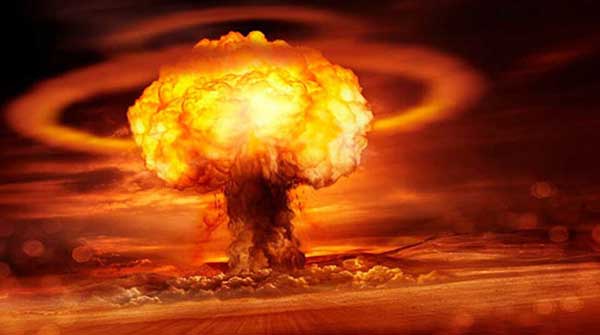
On July 16, 1945, the world’s first nuclear device was tested at a remote location in New Mexico, the Alamogordo Test Range, the Jornada del Muerto (Journey of Death).
The word “bomb” was never used. Instead, it was referred to as the “gadget” or the “thing.” The Manhattan Project was named after the Manhattan Engineer District of the U.S. Army Corps of Engineers, where most of the early research was conducted. While more than 30 research and production sites were used, the bulk of the Manhattan Project was secretly conducted in Hanford, Wash. Oak Ridge, Tenn., and Los Alamos, N.M.
Our four-part series explores how this complex, intricate project was carried out. The Manhattan Project ended the Second World War, but it also ushered in a new age of destructive nuclear weaponry.
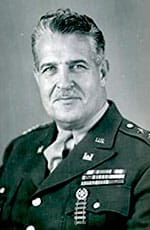
Maj. Gen. Leslie R. Groves
The project, which took three years and cost more than $2 billion, was led by Maj. Gen. Leslie R. Groves (appointed on September 23, 1942), who orchestrated, planned and summoned the most brilliant minds of the time to work on the effort, in addition to building consensus in the federal government and private industry.
Reporting to only one man, Secretary of War Henry L. Stimson, Groves had carte blanche, and no one questioned his authority. More incredible, he had few detractors or critics. And that’s largely because he operated in complete secrecy.
Stimson, a prominent member of the elite Skull and Bones Society at Yale University – the Brotherhood of Death, as it was known – was the bomb’s greatest proponent. When Stimson said the United States proposed using the bomb against Japan, Gen. Dwight Eisenhower – then supreme commander of the Allied Forces in Europe – voiced grave misgivings, firmly believing that Japan was already defeated and that dropping the bomb was unnecessary. But then President Harry S. Truman reluctantly signed off on it. A steadfast Groves was convinced that the bomb would save a million American lives.
One of Groves’ aides said Groves “planned the project, ran his own construction, his own science, his own Army, his own State Department and his own Treasury Department.” How he managed the project – by pulling all the right strings – amounted to both masterful and brilliant project management, not likely to be seen again, according to Cameron Reed, a professor and chairman of the physics department at Alma College in Alma, Mich. Reed is a published expert on the Manhattan Project and the building of the atomic bomb.
“It’s hard to believe that there was or ever will be a project manager who wielded as much power as Groves,” says Reed. “The factories built under the Manhattan Project were equivalent to the capital value of the entire automotive industry of the time. And they were built in less than three years. Groves’ goal was not to build two bombs, but thousands.”
On that hot, dry day in the New Mexico desert in 1945, the testing of the nuclear “gadget” marked the last stage of the Manhattan Project. The next and final stage was to shock the world, sending a powerful message that the United States was a powerful industrial/military force, one to be reckoned with.
The plutonium fuel for the bomb, estimated to be no bigger than a navel orange, was made at a secret laboratory in the city of Hanford in eastern Washington. It took 51,000 workers 27 months to build that small, orange-shaped sphere.
The blast at 5:29:45 a.m. released four times the heat of the interior of the sun – the equivalent of 18,000 tons of TNT – and created a pressure of 100 billion atmospheres. The flash was seen over 400 kilometres away, and shattered windows more than 160 kilometres from the site. The heat was so intense that the tower holding the bomb was instantly vaporized, melting the sand underneath it into green glass. Barely 1.6 kilometres away, surfaces were heated to 750 degrees Fahrenheit. Observers said the flash of light lit up the surrounding mountains brighter than the midday sun.
In that single defining moment, scientists and engineers had unleashed energy that was equal to all the bombs dropped on London by the German Luftwaffe during the Blitz. Following the first blast, the chief scientist and director at Los Alamos, J. Robert Oppenheimer, quoted a Hindu text: “I am become death, the shatterer of worlds.”
Four hours after the test explosion, the cruiser Indianapolis steamed out of the San Francisco Bay carrying a uranium 3-235, 20-kiloton bomb nicknamed “Little Boy.” It was the equivalent of 16,000 tons of TNT. It was headed for the bomber base on Tinian Island in the South Pacific, where it would be loaded on a Boeing B-29, the Enola Gay, on Aug. 6 and exploded 1,850 feet above Hiroshima. Three days later, on Aug. 9, another bomb, nicknamed “Fat Man”, with the power of 22,000 tons of TNT, was loaded onto another B-29 – Bock’s Car – and dropped on Nagasaki, Japan.
To this day, no one knows for sure what the exact death toll was, but approximately 340,000 were killed as a result of the two bombings. If that number is correct, the two “gadgets” killed more Japanese than all the Americans killed in all the battles of the Second World War. It also marked the ending of a war that had already claimed more than 40 million people.
The opinions expressed by our columnists and contributors are theirs alone and do not inherently or expressly reflect the views of our publication.
© Troy Media
Troy Media is an editorial content provider to media outlets and its own hosted community news outlets across Canada.

